 FireOps Calc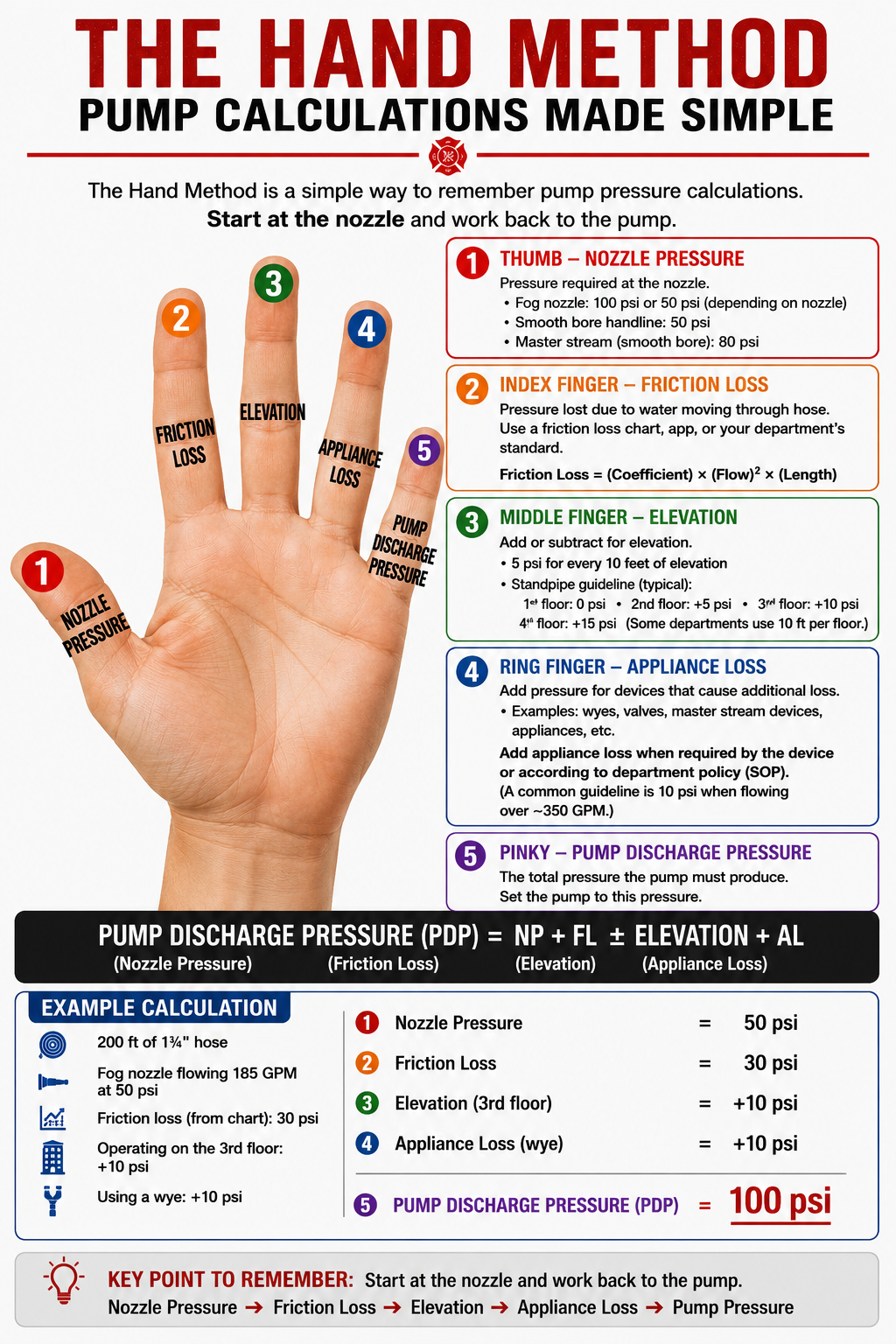
What is the firefighter hand method?
The hand method is a driver/operator teaching shortcut for building a pump discharge pressure calculation in the correct order. It does not replace the underlying math. Instead, each finger reminds the operator which pressure component comes next.
How the hand method works for friction loss
Friction loss is the index-finger step. After identifying nozzle pressure, determine the friction loss for the actual hose size, hose length, and flow. That value can come from your department pump card, hose testing data, a friction loss formula, or the FireOps Calc friction loss calculator. Then add it to nozzle pressure before accounting for elevation and appliance loss.
Important: the hand method does not assign one universal friction-loss number. A 1¾-inch attack line flowing 150 GPM has a different loss than the same line flowing 185 GPM, and department hose characteristics can differ. Use the data your department trains with.
What each finger means
Required pressure at the nozzle.
Pressure lost through the hose.
Add or subtract for height.
Add when the device or SOP requires it.
The final pressure to set at the pump.
Step-by-step pump calculation
Hand method example
Training setup: 200 feet of 1¾-inch hose, fog nozzle flowing 185 GPM at 50 psi, 30 psi friction loss, 20 feet of elevation, and a wye requiring 10 psi appliance loss.
Training answer: 100 psi PDP. In operations, use your department hose/nozzle data and SOP.
Common mistakes
Use a known chart, hose data, formula, or calculator instead of memorizing one number for every line.
Do not assume every fog nozzle or smooth bore uses the same pressure.
Above-grade and below-grade operations change the required pump pressure.
The calculation is the starting point. Confirm actual stream and crew feedback.
Practice the hand method in company drills
Once students can build the calculation on paper, use it during timed engine-company evolutions. The FireOps Calc NFPA 1410-style drill library gives crews repeatable attack-line, hydrant, standpipe, master-stream, relay, and reverse-lay scenarios where pump math can be applied under realistic training pressure.
Hand method FAQ
What is the hand method for friction loss?
Friction loss is the index-finger step in the firefighter hand method. Determine the actual hose friction loss for the selected hose, length, and flow, then add it to nozzle pressure.
What is the firefighter hand method formula?
PDP = NP + FL ± elevation + appliance loss. The hand method simply helps students remember that order.
Does the hand method replace a friction loss calculation?
No. It tells you where friction loss belongs in the pump calculation. You still need to calculate or look up the correct friction-loss value.
Does this replace department SOPs?
No. This page is for training and review. Always follow department pump procedures, hose/nozzle data, and instructor guidance.